
FEATURE
IGNANT
ROBERT ROTH PAINTS HOW THE LIGHT GETS IN
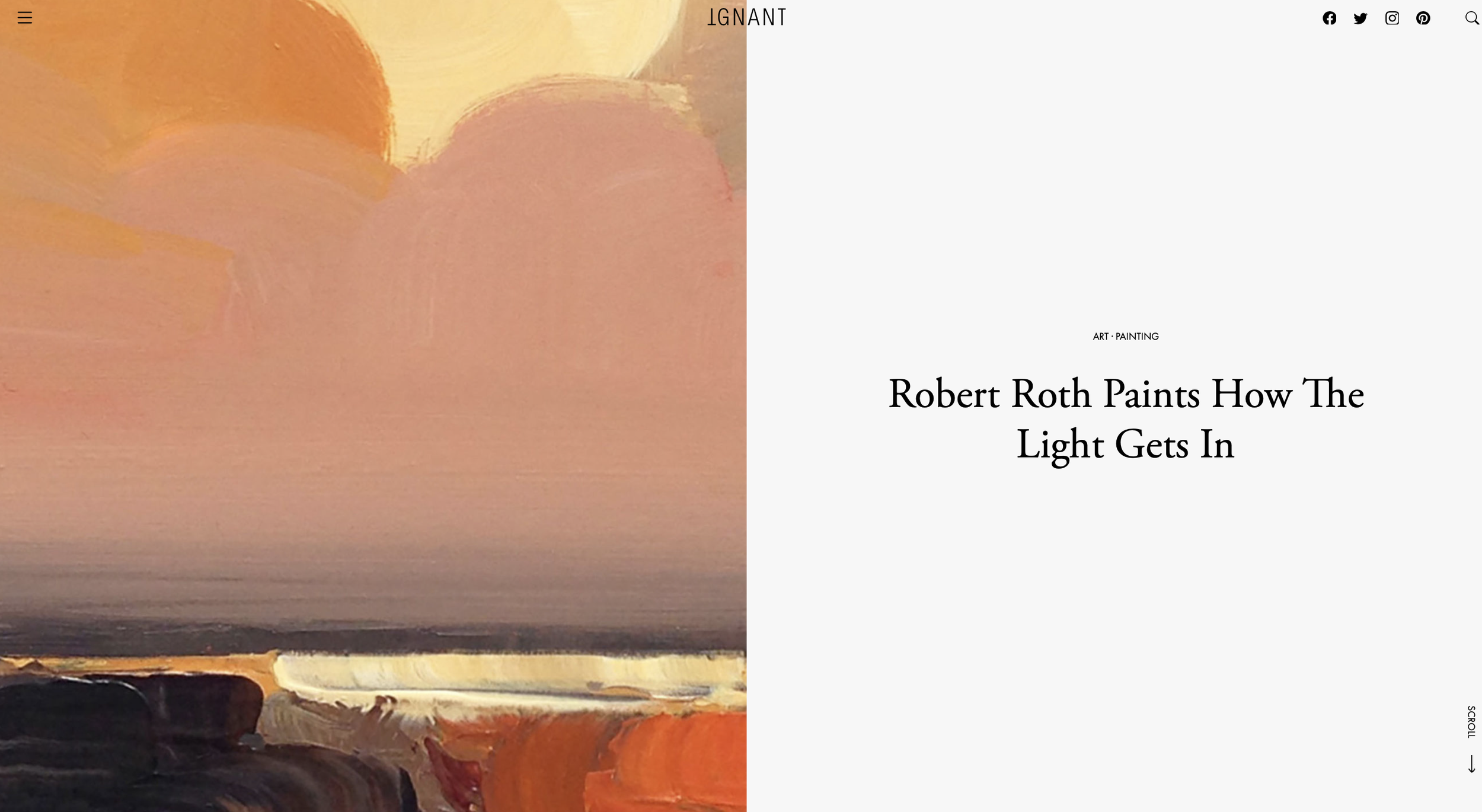
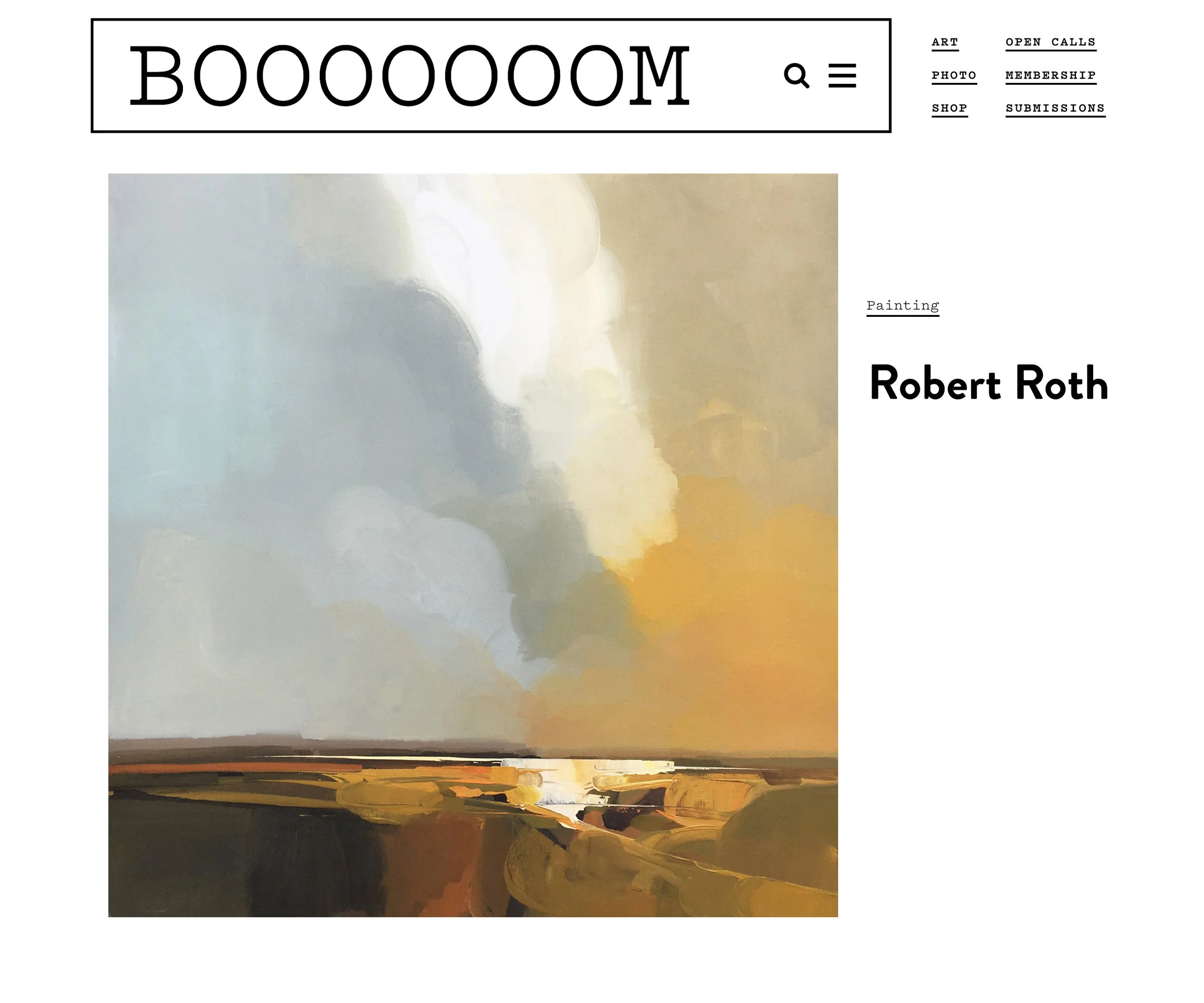
His paintings transfer the infinite quality of the sky, and its relationship to land and water, to canvas. Though Roth is often considered a landscape painter, the horizons that he paints sit low on the canvas; the land secondary to the might of the sky. “Skies are a powerful form of nature, revealing endless compositions of light and color.” powerful form of nature,” Roth explains, “revealing endless compositions of light and color.” But when every blazing sunset is captured and posted to Instagram, often artworks that render such horizons fail to inspire any great sense of awe. Roth, with his fast, broad brushstrokes, manages to paint such scenes in new ways. His paintings transfer the infinite quality of the sky, and its relationship to land and water, to canvas. “Within my paintings, I try to achieve that sense of vastness as the reflective light travels throughout the low horizon and across the waterways, lighting up the ground,” Roth tells us. “My paintings are really abstract studies of skies and the landscape just happens to sneak in.”
- Rose Flanagan
REVIEW
CLEVELAND SCENE
EAST HAMPTON / Robert Roth demonstrates a thoughtful display of paintings inspired by New York's Long Island. Acrylic dries rapidly, but Roth doesn't seem hurried, even as he captures all the sensory details of the island's active skies and marshy, windswept landscapes with a brisk, almost blunt hand. "East Hampton" is the show's most balanced, elegant entry. Here, seemingly boundless, soggy grasslands -- their subtle patchwork of greens interrupted only by occasional fingers of whitish-blue streams -- unfurl into the horizon. You can almost hear the squish beneath your feet and feel your boots getting muddy. All this takes place beneath a vast but placid sky, compounding the magnificent remoteness of the scene. This is the basic format of most images, and green, blue, and gray predominate, but in "Bay Overlook," Roth makes a tasteful exception, applying shocking touches of brilliant orange and misty pink to convey flecks of light on the water and the glow of the setting sun. The air, too, is restless. Roth brushes on thicker layers and even globs of paint to portray the onset of evening. For sheer deftness, take note of "Cove," in which Roth incorporates some minor imperfections on his wooden surface into a generally rainy composition, transforming the board's tiny pocks into precipitation, like drops of water on a camera's lens.
- Zachary Lewis
INTERVIEW
CONTEMPORARY COLLAGE MAGAZINE (UK)
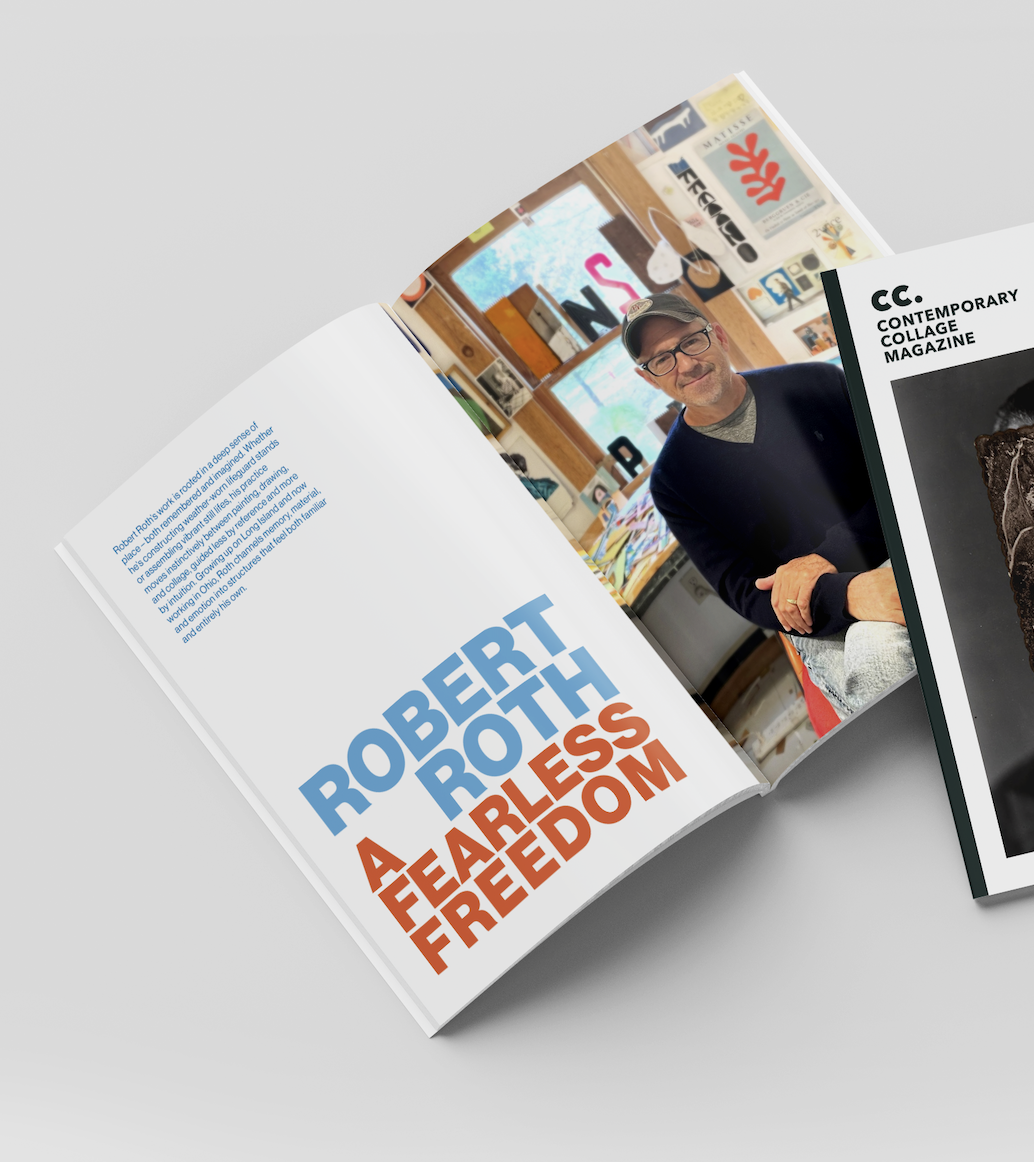
Robert Roth’s work is rooted in a deep sense of place – both remembered and imagined. Whether he’s constructing assembling vibrant still lifes, or weather-worn stands or his practice moves instinctively between painting, drawing, and collage, guided less by reference and more by intuition. Robert channels memory, material, and emotion into structures that feel both familiar and entirely his own.
- Les Jones
Robert Roth A FEARLESS FREEDOM
Edited excerpt from an interview with Les Jones, Contemporary Collage Magazine (UK)
LJ: Hi Rob, it feels to me that your collage work is very much a result of ‘place’ — either real or imagined. Would that be a correct observation?
RR: I think that’s a fair observation. The places in my work are mostly coming from my subconscious. I rarely work from reference in collage because, for me, it doesn’t really help. If I make a sketch or use a photograph, I take it in and then put it away. I can’t have it sitting in front of me while I’m working because I’ll start following it too closely. Even if it’s just in my peripheral vision, it can disrupt the flow. Most of the time, I don’t really know what the piece is going to look like when I begin. I just start, and the place gradually reveals itself as I work. I’m not trying to describe a place so much as discover one.
LJ: I’m presuming that you would class yourself as a painter, and that collage is something that works in around your main activity?
RR: For me, it’s really a combination of all three. Yes, I’m a painter, but drawing is my foundation. I have hundreds of sketchbooks, although I rarely show them. Drawing has always been at the core of how I see and understand the world. I actually started out as a watercolour painter. That was my jam. I’d take my paints out on location and try to capture the feeling of a place rather than simply record what I was seeing. Over time, painting took me a certain distance, but I eventually wanted to push beyond it. Collage became essential—it allowed me to combine painting, drawing, texture, and found material in a single language. If I had to choose one medium, I’d lean toward collage, because it naturally brings everything together.
LJ: What is it specifically about collage that resonates with you?
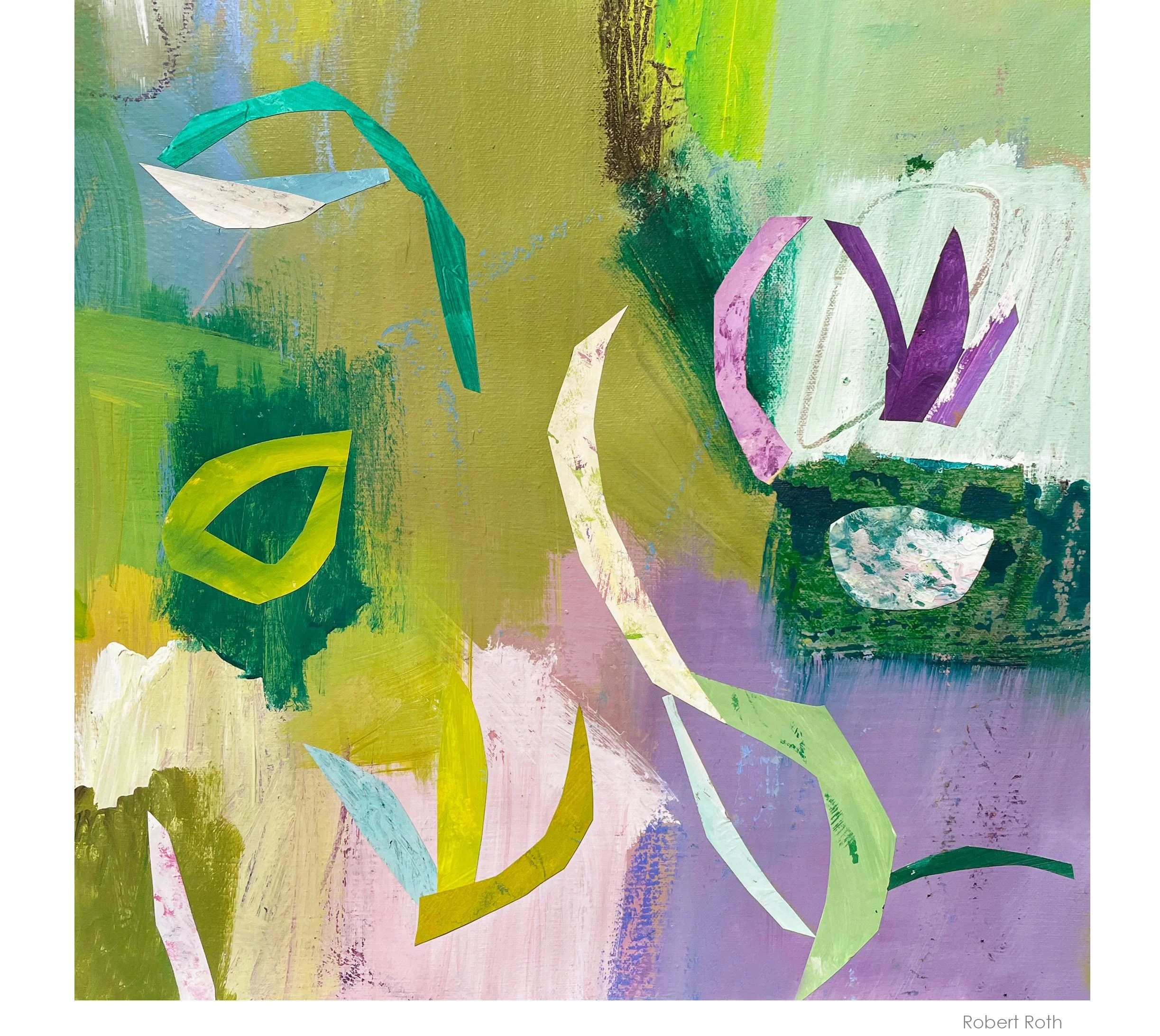
RR: What resonates with me most is the freedom of collage. There’s a fearless freedom to it because nothing is fixed—you can move things around, shift relationships, and change direction instantly. When I graduated from RISD, my work was fairly traditional. Then I discovered the Abstract Expressionists, particularly Robert Rauschenberg, and it completely changed everything for me. I remember thinking, “There are no rules. Let’s go.” I even wrote Rauschenberg a letter once, sending him some of my early works and he wrote back. From that point, collage became a kind of new language for me. I began working with painted papers, wood, printed material, and fragments of surface that I later cut and reassembled in the studio. My tables are covered in these pieces—like a constantly evolving archive.Sometimes my shapes take on an almost Picasso-like quality, though it’s never intentional. It’s simply part of the visual language that emerges when I allow intuition to lead the process.
LJ: They have a Cubist feel to them — that perspective so they become flat shapes rather than three-dimensional objects.
RR: Yes, I definitely flatten the space and alter the sense of perspective. I spent many years painting from life and working from still-life setups, focusing on light, shadow, and dimensionality. But over time, I became less interested in describing exactly what I see and more interested in inventing my own visual language from that. Finding collage was a turning point for me. It felt like discovering an entirely new language. I wasn’t limited by observation anymore—I could push shapes, compress space, and create a world with its own logic. I also remember coming across William Scott and realizing that still life doesn’t have to be still. That was a revelation. The objects could become abstract shapes, and the arrangement itself could have movement, rhythm, and play. What’s interesting is that when I cut my vessel forms, they often feel quite primitive, almost like my blind drawings. I’m not consciously trying to do that—it just emerges. For me, that’s where the excitement is: taking familiar forms and letting them drift into something more abstract and open.
LJ: Let’s move onto your Still Life series, they have a very free spirited approach.
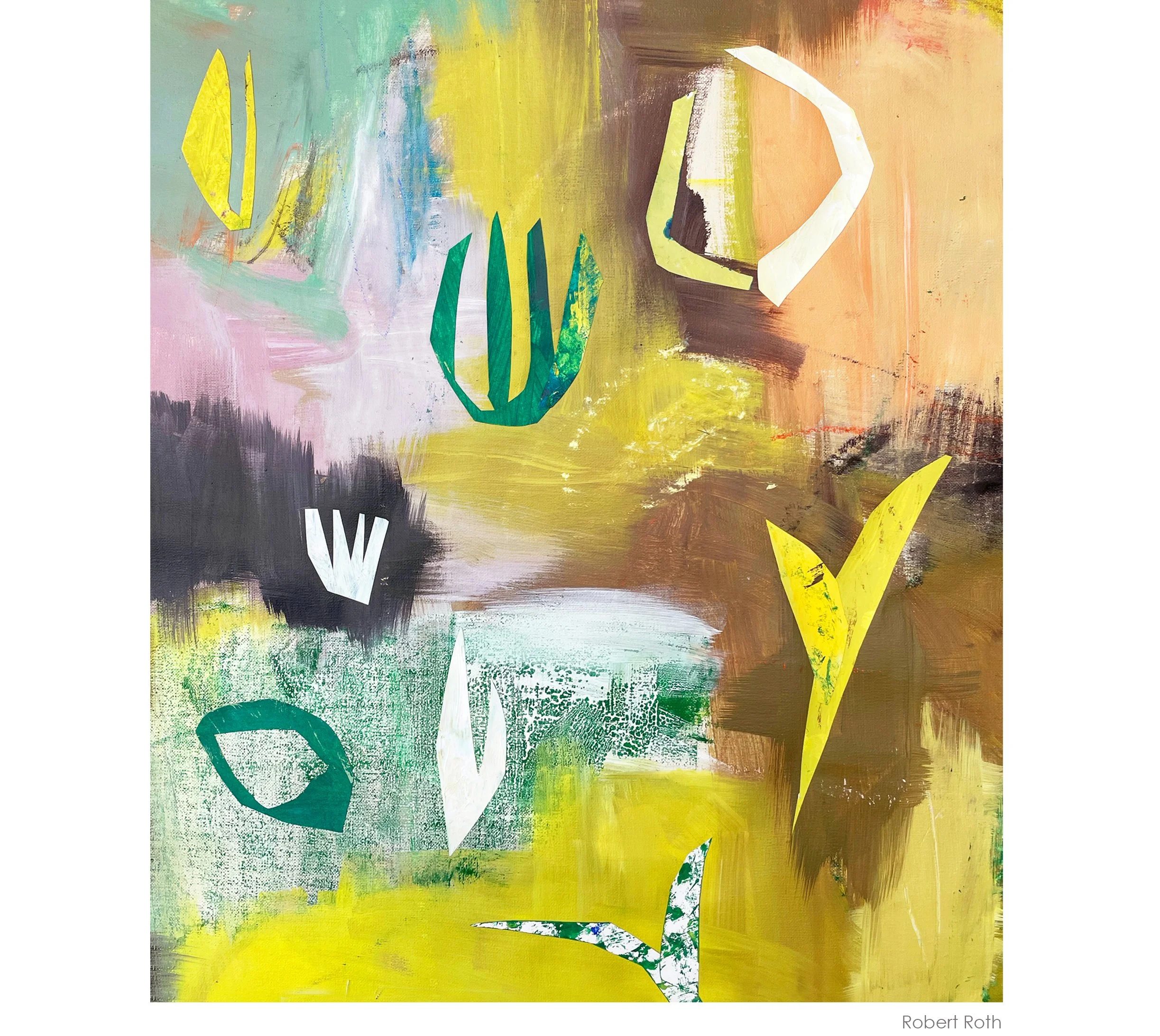
RR: There’s a lot going on in those pieces. When I’m working on them, I often don’t even know which end is up at the beginning. I’ll rotate the work, turn it upside down, and keep working until something begins to resolve itself. The vessel forms come from memory and intuition. I’ve always loved pottery and mid-century ceramics—their shapes, their presence—but I don’t work from them directly. Instead, I build the work in layers. Painted backgrounds, collage fragments, printed surfaces—all coming together gradually. What interests me is the meeting point between abstraction and representation. The background often comes from somewhere I can’t fully explain, while the vessel forms offer a familiar anchor. The work becomes a conversation between those two worlds.
LJ: A few times during this conversation, you’ve said, “I don’t know where that comes from.” Do you get a sense of channelling something in some way?
RR: Yes, I think when I get it right, that’s exactly what happens. When I know what I’m doing, it’s never very good. The more I try to control the outcome, the more the work tightens up.Sometimes it takes a while in the studio before something connects. At first, I’m often trying too hard. Then suddenly something shifts, and I stop forcing it—that’s when the work starts to move on its own. You can’t really plan for that moment. You just have to show up and keep working. Sometimes I’ll spend an hour cutting shapes and end up with nothing useful because I’m trying too hard. Then I’ll cut one in half, and the piece that falls on the floor becomes the one I use. That’s usually when I know I’ve relaxed enough to let intuition take over. I think the subconscious has its own voice, and the best work seems to happen somewhere between that and the analytical mind.
LJ: Would that be your advice to artists who are struggling to find their voice — to just let it go and not think about it?
RR: I think there’s truth in that. When you’re trying too hard, you’re usually in judgment mode. You’re thinking ahead instead of being present. At its core, art is play—experimentation, curiosity, and invention. My advice is to follow the ideas that genuinely excite you. Stay curious. Try new things. Change your environment. Break your habits. And give yourself some grace in the studio. Some days the work will be terrible—and that’s fine. I often tell myself, “I’m going to allow myself to make the worst thing ever.” That takes the pressure off completely. Don’t focus on making something good. Focus on making something honest. Be open. Be bold. Be yourself. That’s where the good stuff lives.
FEATURE
BOOOOOOOM
ROBERT ROTH : THE ENERGY BETWEEN THINGS
Roth’s atmospheric paintings are built from the energy and experience of nature. Shaped by the invisible currents of place—memory, perception, and the quiet hum of being in the world. Roth describes, “That feeling you get when you look up and suddenly everything feels bigger and quieter at the same time — that's what I'm chasing.”
- Jeff Hamada